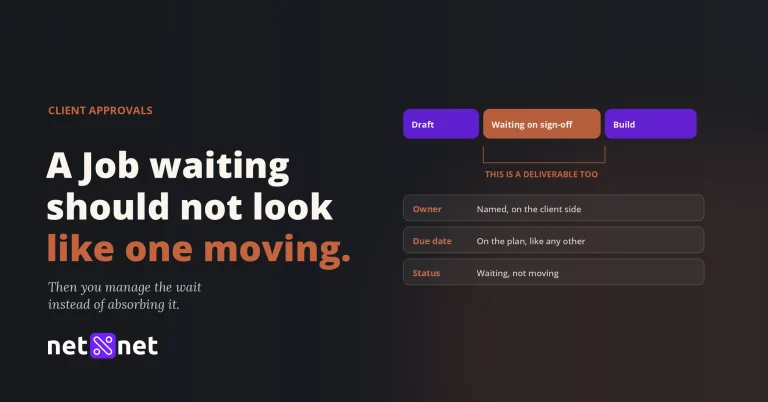

How do you resolve client-side disagreements before they stall the Job?
When the people on the client side disagree with each other, the work stalls in the gap. The fix is to surface the conflict early, get one decision-maker named, and put decisions in writing attached to the work. You are not refereeing their politics. You are protecting the timeline from their indecision.
When people on the client team disagree, the project rarely stops with a dramatic announcement. It slows in a more familiar way. Feedback contradicts other feedback. Approvals cancel each other. Meetings end with vibes instead of a decision. The team keeps working, but the Job starts drifting in the space between opinions.
The source article offers a solid set of moves. The useful thread through them is simple: make the decision path clearer than the disagreement.
Start by naming one decision-maker
This is the source’s first tip, and it is the most important one.
If multiple people can weigh in but nobody can break a tie, the project has no steering wheel. The client team does not need to stop talking to each other. One person just needs the authority to make the final call and keep the Job moving.
This helps everyone. Your team knows whose approval counts. The client side knows how decisions will close. And when a real disagreement surfaces (say, a committee arguing for the sixth week about the button color), you are not stuck waiting for group consensus that may never arrive on its own.
Establish the goals before the taste debate starts
The source is also right to push goals and objectives early.
If the client team has not agreed on what the project is trying to do, they will fall back on preference. One person likes one direction, another prefers something else, and nobody has a shared standard for picking between them. That is when the Slack thread turns into a debate about shades of blue.
Writing the goals down gives the conversation somewhere firmer to stand. When conflict shows up, you can point back to the purpose of the work instead of leaving it at “I like this one better.”
Keep communication open, but structured
Open communication matters, but openness alone is not enough. Unstructured discussion can actually drag a disagreement out. Every meeting produces more opinions without moving toward a decision.
That is why the source’s other tips have to work together. Clarify roles. Make the discussion visible. Set decision windows. If a piece of work needs review, define when and how the review closes. A little structure is what keeps the conversation from becoming endless.
Use artifacts that make the choice easier
The source calls out visual aids: wireframes, mockups, mood boards. The broader point is worth borrowing. Give people something concrete to react to.
Disagreement gets worse when everyone is arguing from a slightly different mental picture. A clear artifact shrinks the ambiguity. It helps the client side compare options, spot what they actually disagree about, and land on a decision that can be written down cleanly.
Put decisions in writing and attach them to the work
This is where a lot of firms still lose context after the meeting ends.
If a decision lives only in a call, a side DM, or somebody’s memory, it will get reopened later. Write the decision down and keep it attached to the work item it belongs to. That way the team can see not only what was chosen, but where that choice belongs inside the Job.
When chat and decisions stay close to the work, the project spends less time reconstructing who said what. Why is agency chat always chaos, and how do you fix it?
Protect the timeline from indecision
Not every disagreement needs a perfect compromise. Sometimes the most important move is making a decision before the calendar absorbs another week of delay.
That is why the tips on deadlines, structured decision-making, and expectation management still hold. If a client-side conflict is going to drag on, it should show up as a timeline risk. Then the conversation becomes about what has to happen for the work to move, not about whose preference wins.
A light way to support this operationally
When the decision-maker, the current status, and the recorded discussion all live close to the work, moving conflict toward closure gets easier. In a workflow management tool like Net Net, that means the decision trail stays attached to the Job itself instead of being scattered across a dozen unrelated channels.
The bottom line
Client-side disagreements stall projects when nobody owns the final call and decisions are allowed to float loose from the work itself.
Name one decision-maker. Get the goals down early. Put concrete artifacts in front of people. Write decisions down where the team can find them later. That will not remove the client’s politics, but it will keep the timeline from getting trapped inside them.
FAQ
What do I do when the client side disagrees?
Surface the disagreement early and move the conversation toward a clear decision path. That usually means going back to the project goals, naming who has final authority, and writing the choice down once it is made. The aim is not to solve their internal politics. The aim is to keep the Job moving.
How do I get a client to make a decision?
Make the decision easier to close. Present concrete options, spell out what the timeline depends on, and clarify who needs to sign off. If several voices are involved, push respectfully for one final decision-maker so the review does not stay open forever.
Who should sign off on deliverables?
The client should name one person whose approval closes the loop, even when others contribute input. Collaborators still get a voice. It just prevents the project from getting stuck between two people at the client who cannot agree on a final answer.
What is the most common mistake in these situations?
Letting the disagreement stay informal. When nobody writes down the open issue, who owns the decision, or what the delay is costing the timeline, the team keeps circling the same conflict instead of resolving it.
See your work before it drifts.
Net Net keeps plan and effort side by side, so you catch the slip while there is still time to act.
Start your free trial