
Should I tell clients when my team uses AI?
Yes. Tell clients that AI may support the process, but keep the conversation on judgment, data handling, and who owns the final result. Clients hire your firm for expertise, taste, decisions, and accountability. A draft tool does not take any of that off your plate. Put a plain AI-use clause in the agreement, explain the human review behind every Deliverable, and record any client restrictions where the whole account team can see them. Transparency should make the working relationship clearer, not turn the kickoff into a tour of your software stack.
Why transparency beats saying nothing
Silence lets both sides invent their own policy. The client may assume no AI touches the work. Your team may assume routine use needs no discussion. If those assumptions collide halfway through delivery, the trust problem can become much larger than the tool use that started it.
Transparency does not require a dramatic announcement or a list of every tool. It means setting a clear expectation about the role these tools may play, the data protections around them, and the human responsibility for the final work.
That conversation also helps you uncover client-specific boundaries early. Some clients have contract terms, security policies, industry requirements, or internal preferences that limit use. Learning that during contracting is much easier than learning it after delivery has started.
What clients are actually paying you for
Clients hire a firm to understand the situation, make decisions, produce work that fits, and stand behind the result. Software has always helped with the process. The value is still in the judgment before the tool, the review after it, and the person willing to put their name on the Deliverable.
AI assistance does not understand the client by magic. A first draft without context can save no time at all. A summary can miss the decision that mattered. A polished concept can still be completely wrong for the audience. Your team earns the fee by selecting, correcting, shaping, checking, and taking responsibility.
Keep the conversation at that level. Explain the quality standard, not a minute-by-minute production method. The client should know that the tools do not lower the review bar or change who is accountable.
Where AI belongs in the conversation, and where it doesn’t
AI belongs in the conversation when it touches client data, contract expectations, ownership questions, or a meaningful part of the agreed process. It also belongs there when the client asks. It does not need its own segment in every status call or a footnote on every brainstorm.
It does not need to dominate every status call. You do not need to identify every AI-assisted sentence, meeting summary, or internal brainstorm unless the agreement requires that level of disclosure. Excessive tool narration can distract from the work and create confusion about what matters.
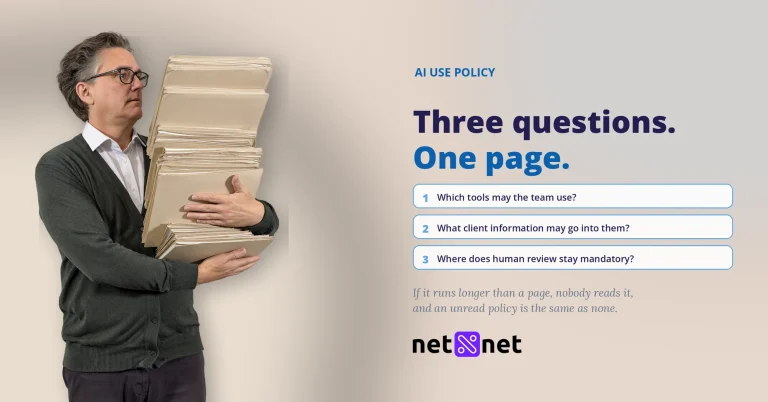
Use a consistent firm-wide position, then add client-specific rules where necessary. Your internal policy should tell the team which accounts have restrictions and where those restrictions appear in the workflow. How do I set an AI use policy for my agency? provides a practical starting point.
Put a simple clause in your agreement
Keep the clause short enough for a normal person to understand. State that the firm may use approved AI tools to support its process, that client information follows the agreement and the firm’s data rules, and that a person reviews and owns every final Deliverable. Then make sure the actual workflow can keep those promises.
Avoid promises you cannot operate. If you say no client data ever enters any AI-supported system, make sure every employee, contractor, transcription service, and connected tool follows that rule. If exceptions are possible, define the approval process.
Also state that a client can identify additional restrictions in writing. When a client opts out, record the boundary where the whole account team can see it. The sales conversation and delivery workflow need to match.
The clause is not a replacement for reviewing ownership, confidentiality, and data terms with qualified counsel. It is the plain operational statement that helps both sides share the same expectation.
Frame it around human review and accountability
Tell the client what human review means for their work. Depending on the Deliverable, the team may check facts, sources, originality, brand voice, accessibility, technical accuracy, or alignment with the approved direction. Give that review a named owner and a real task. “Someone will look it over” is not much of a quality system.
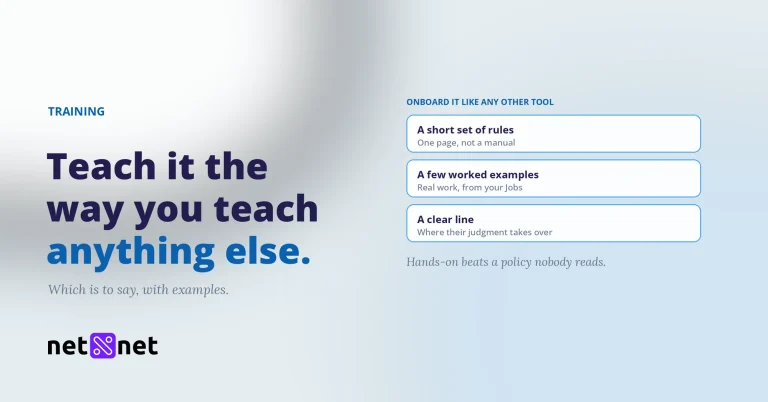
Build the review into the project plan. AI-assisted work should not rely on someone remembering to “look it over.” Give it an internal review task, an owner, and a clear finish line before client delivery.
Track the review effort too. If the AI-assisted draft takes longer to verify, rewrite, and explain than the original task would have taken, the tool did not save that workflow anything. Small firms need the actual effort, not the story everyone expected the tool to tell.
The delivery promise stays the same: the client receives work that meets the agreed standard, and your firm is accountable for it.
Answer client concerns about quality and originality
If a client worries about quality, explain the review. If they worry about originality, explain how the team checks the work and why raw output is never the Deliverable. If confidentiality is the concern, describe the approved tool and data boundaries without promising more than you have verified. Ask what specifically worries them before answering the version of the question you expected.
Do not dismiss the concern as resistance to technology. The client may have a legitimate policy or a past experience that shapes the question. Ask what specifically worries them and respond to that.
If the client requires a fully human process, decide whether the firm can support it, document it, and estimate the effort accordingly. That boundary may change the workflow and timeline, so set expectations early. The same principle applies to other delivery conditions, which is why clear client expectations on timeline and turnaround matter too.
FAQ
Will clients think they are paying too much if they know AI was involved?
That worry grows when the tool is framed as the product. Keep the conversation on the expertise, judgment, review, and accountability the client is buying. The firm still has to understand the problem and stand behind the result, even when AI is part of the delivery team.
Do I need to disclose every tool my team uses?
No. You do not itemize every app in your stack, and the same applies here. What clients care about is that their data is protected and that a person stands behind the quality of the work, so address those directly.
What if a client asks us not to use AI at all?
Respect it, put it in writing, and make sure your team knows the account has that boundary. Some clients have real contractual or confidentiality reasons, and honoring the request is part of earning their trust.
See your work before it drifts.
Net Net keeps plan and effort side by side, so you catch the slip while there is still time to act.
Start your free trial