
How do I keep handoffs from breaking down between people?
Handoffs break when the last person thinks they are finished and the next person does not know the work is theirs. Give every step one owner, define what “done” includes, and signal the transfer inside the workflow. The new owner should know what arrived, where the files live, and what happens next. A surprising amount of “slow work” is perfectly normal work sitting untouched because the handoff happened only in somebody’s head.
Why work stalls in the gaps between people
A Job can look slow even when nobody is working slowly. Design finishes and waits for copy. Development expects approved files that never formally arrived. The account lead assumes production saw the client’s note. Everyone is busy, but the task sits still because the ownership changed without a clean transfer.
These slowdowns are hard to spot because they do not look dramatic. There is no crisis meeting and no visible blocker. Work simply stops moving. That is why firms can feel overwhelmed even when individual tasks do not seem especially difficult. The real issue is not task complexity. It is that ownership changed hands without a clean transfer.
Give every task a single clear owner
Shared responsibility sounds friendly in a meeting and gets murky in delivery. If two people partly own the next move, both can reasonably assume the other has it. Use one owner at a time. That person can need input from half the studio, but there should still be one name attached to moving the task or raising the blocker.
Single ownership also improves follow-up. If a project lead wants to know where something stands, there is one person to ask and one person responsible for moving it or escalating a blocker. That removes a lot of the ambiguity that makes stalled tasks linger longer than they should.
Define what ‘done’ means for each step
Handoffs get messy when “done” means whatever the last person meant that day. Is design internally reviewed? Are mobile files included? Is the client approval final? Are open questions documented? The next person should not have to inspect the evidence like a tiny project detective before they can start.
Defined completion criteria solve that. For one team, “ready for development” may mean approved desktop and mobile files, asset exports, and open questions resolved. For another, “ready for client review” may mean draft copy loaded, QA complete, and the review link prepared. The exact definition matters less than the fact that it exists and is shared.
Make status visible so no one has to ask
Put the status on the work itself. The team should be able to see whether a task is waiting, ready, blocked, or complete without searching a chat thread or asking the person who is out today. Visible status shortens the dead space between one person finishing and the next person beginning.
This is where workflow management software earns its keep. If the status lives in the work, everyone can see what changed and what is waiting. That lowers the coordination burden on project leads and reduces the number of tasks that disappear into personal to-do lists. It also makes problem spots easier to find later because the pattern of waiting becomes visible.
Signal the handoff so the next person knows
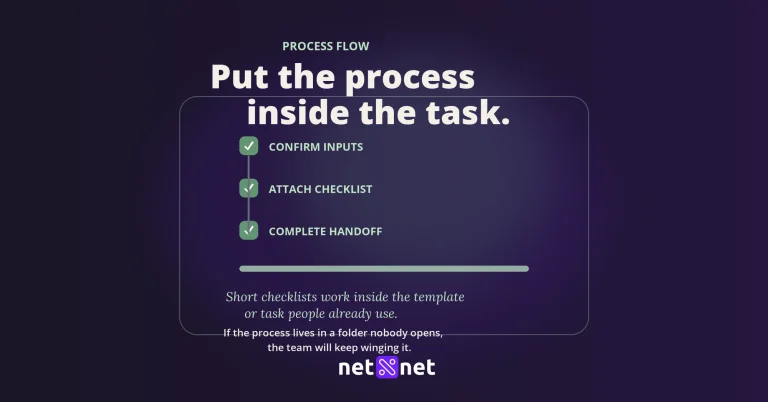
Visibility alone is not always enough at an important transition. Signal the next owner when the task moves, and send the useful context with it: what is finished, what remains, where the files are, and anything unusual. “It’s ready” is not much of a handoff if the receiver needs a meeting to learn what “it” is.
The signal should also include context. A clean handoff tells the receiving person what is complete, what remains, and anything unusual that affects the next step. If the task moves without that context, the receiver must reconstruct the state of the work by asking around or digging through files. That is exactly where avoidable delay starts.
Spot the handoffs where work keeps piling up
Every firm has a few repeat problem spots. Maybe strategy to design always slows down. Maybe QA waits on development too long. Maybe approvals sit between account management and production. The useful move is to identify those recurring choke points and inspect the handoff itself. Is ownership unclear? Is “done” too vague? Is the status invisible? Is the next person not being signaled?
Once you find the weak handoff, the fix is usually practical: a better checklist, a clearer status, a named owner, or stronger standard workflows. Cleaner transfers also make timeline expectations easier to hold. Most teams do not need another speech about communication. They need the transfer built into the Job so it happens on an ordinary Tuesday, not only after the last one went sideways.
FAQ
What information should travel with a handoff?
Send enough context for the next person to begin without scheduling a reconstruction meeting: what is finished, what remains, where the files live, what was approved, and anything unusual. If the receiver has to dig through chat and ask three people, the handoff is not complete yet.
How do I know where our handoffs are failing?
Look for the tasks that sit untouched for days without anyone flagging them. Those quiet gaps, not the visibly hard tasks, are usually where ownership was unclear and the work stalled between people.
Do more handoffs mean more risk?
Every handoff is a point where work can stall, so fewer, cleaner ones are better than many blurry ones. When a step must change hands, make the transfer explicit rather than assuming the next person is watching.
See your work before it drifts.
Net Net keeps plan and effort side by side, so you catch the slip while there is still time to act.
Start your free trial