
How do I price a project when I can’t predict the effort?
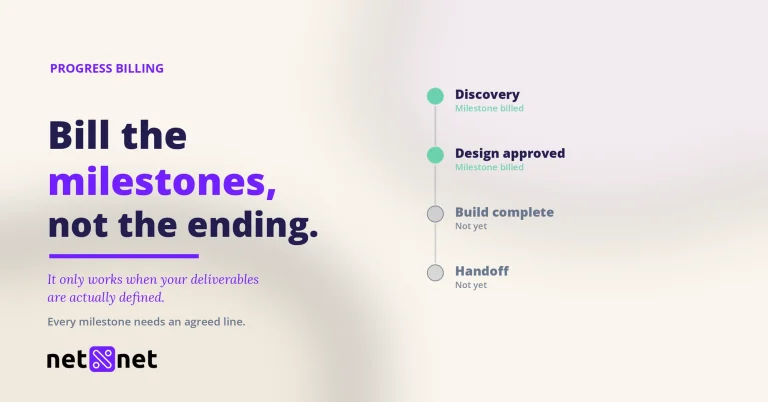
When the effort is genuinely uncertain, do not trap the whole project inside one confident fixed number. Price the first phase closely, give a range for the work that depends on what you learn, and put a review point where the biggest unknowns should clear. After the audit, prototype, or discovery work, confirm the remaining scope before the team continues. That keeps the quote tied to what you know instead of making your shop finance the client’s uncertainty.
Why fixed quotes fail on unpredictable work
A fixed quote is only as good as the scope underneath it. Familiar work with clear inputs and a known approval path can support one. Unfamiliar work cannot borrow that certainty just because a single number looks cleaner in the proposal.
The usual failure is not that the team works slowly. It is that the early quote assumed answers that nobody had yet. The old system needs more cleanup than expected. The client has three decision-makers instead of one. The content arrives in five formats. A technical dependency behaves differently in production. Each discovery adds real effort, but the original quote has nowhere for that effort to go.
This is why a firm can deliver strong work and still lose control of its capacity. The estimate was treated as a promise before the work was understood.
Size what you know, range what you don’t
Sort the Job into work you know, work you can compare, and work nobody can size yet. Known work gets a tight estimate. Comparable work gets a range based on similar Jobs. The unresolved part gets a small first phase designed to answer the questions that are blocking a better estimate.
For example, a redesign may include a well-understood discovery workshop, a reasonably familiar design phase, and an uncertain migration. Quote the workshop closely. Give design a range based on the number of page types and review rounds. Treat migration as a separate phase whose estimate becomes firm after the audit.
This is not evasive pricing. It is a clearer description of what you know today. If every piece still feels too large to size, use the process in How do I break a big project into estimatable pieces? before building the quote.
Build the quote from effort, not a round number
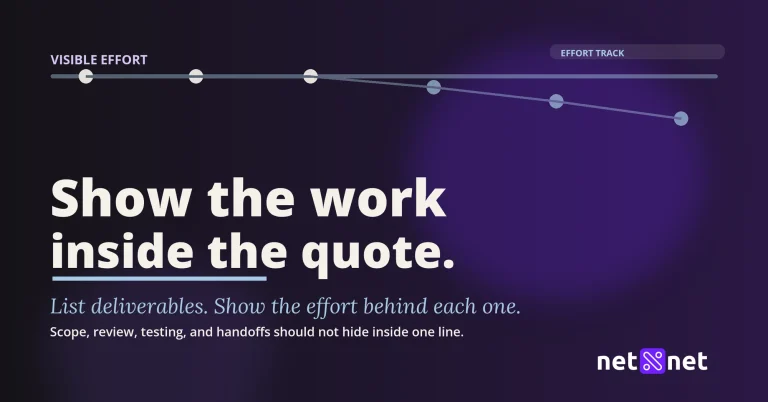
Build the quote from the people and roles each phase actually needs. Include strategy, design, development, project management, testing, review, and handoff where they apply. Then check the spaces between the obvious production tasks. Someone still has to run the client call, consolidate the notes, chase the asset, and make the thing ready for the next person.
This bottom-up approach exposes weak assumptions. If the design phase contains only design hours, ask who is handling review notes, client calls, file preparation, and handoff. If development has no testing effort, the quote is incomplete. If project management appears as a token line, check whether the meetings and coordination have been counted.
A round figure chosen because it feels acceptable may still land near the right answer, but you will not know why. An effort-built quote gives you something you can revise intelligently. When one phase changes, you adjust that phase rather than inventing a new total.
Add review points where the unknowns resolve
A review point is where the estimate is supposed to get smarter. Put it after the audit, discovery phase, prototype, or technical test that should remove a major unknown. Define what the team will know then and what decision follows. Otherwise, “we will revisit this later” is just uncertainty wearing a calendar invite.
Define what the checkpoint will answer. It might confirm the number of templates, the condition of the data, the integration approach, or the approval path. State what the client receives at that point and what happens next. The next phase can move forward within the original range, receive a firm figure, or be reshaped if the findings change the job.
The checkpoint should appear in the proposal and the delivery plan. It is not a private reminder for your team. When both sides know a decision is coming, new information feels like part of the process instead of a surprise request to revisit the quote.
Explain the range to the client without losing the deal
Clients usually object to a range when it feels like a shrug. Show what holds the work near the low end and what moves it higher. Be plain: “We can size discovery closely. Implementation depends on what the audit finds. We will confirm that phase before you authorize it.” That sounds controlled because both sides know how the number will become firmer.
Use plain language: “We can size discovery closely. The implementation range depends on what the audit finds. After the audit, we will confirm the implementation effort before you authorize that phase.” That sounds controlled because it is controlled.
You can also set a decision boundary. The team does not proceed past the review point without the client’s approval of the refined scope. That gives the client more control than a fixed quote that later produces change requests. For a fuller comparison of where each pricing structure fits, see Fixed fee or hourly: which pricing model fits your firm?.
Refine the estimate as the work reveals scope
The estimate should tighten as the Job reveals itself. After each phase, compare planned effort with actual effort, record what changed, and update the remaining range. If every phase is landing near the high end, do not wait for the final invoice to notice. Check the remaining capacity and timeline while you still have options.
Keep the revision visible to the team. If discovery used more effort but reduced implementation uncertainty, the project may still be healthy. If every phase is landing near the high end, check whether the remaining capacity and timeline still hold. Workflow management software can keep the estimate, actual effort, ownership, and timing connected as the plan changes.
The goal is not to predict unfamiliar work perfectly on day one. The goal is to make uncertainty explicit, learn early, and keep the commitment tied to what the team can actually deliver.
FAQ
Should I just pad my estimate to be safe?
Padding hides which part of the Job is uncertain, and the buffer often disappears without teaching you anything. A stated range with a real review point is clearer for the client and safer for the team because nobody has to pretend the unknown work is already known.
How do I explain an effort range to a client without sounding unsure?
Frame it as a professional read on the work: you know the first phase precisely and you will confirm the rest once discovery removes the guesswork. Clients trust a range backed by a plan far more than a single number that quietly balloons later.
What if the client wants one fixed price no matter what?
Then price the part you can define and scope the rest as a separate phase with its own quote once the work is understood. Committing to a fixed number on effort you cannot yet see is how jobs drift past capacity and get undersold.
See your work before it drifts.
Net Net keeps plan and effort side by side, so you catch the slip while there is still time to act.
Start your free trial