
Should I track time if I bill by value?
Yes. Value pricing changes what you charge, not what the work costs you in effort. Tracking effort against every deliverable is how you know whether the price was right, which Jobs drift, and when a retainer quietly outgrows its scope. Without it, next quarter’s pricing is a guess wearing confidence.
What a time-tracking webinar gets right about value pricing
I recently watched a LinkedIn Live webinar called “Find the Best Time-Tracking Strategy Without Frustrating Your Team,” hosted by Melissa Morris of Agency Authority and Marcel Petitpas of Parakeeto. They treated tracking as an operating habit, not a billing ritual. That distinction matters to any owner who needs to know what delivery actually takes, whether the client ever sees an hourly number or not.
That matters even more for small firms. Promethean Research reports that 59% of digital agencies have fewer than 10 full-time employees. In a shop that size, a few overloaded people, a few underpriced deliverables, or a few messy handoffs can distort the whole quarter. You do not need a finance department to feel that. You feel it in deadlines, in team strain, and in the gap between a sold scope and the work it actually takes to finish it well.
At Right Here Interactive, my own agency, effort tracking has stayed useful for exactly that reason. It gives us something better than a confident retelling after the Job ends. We can see what the work actually took.
Value pricing does not make effort tracking optional
This is the most common mistake in value pricing.
Owners hear “bill for value, not hours” and conclude that tracking is now optional. But value pricing only changes the pricing model. It does not change the labor, coordination, revisions, approvals, or production load required to deliver the work. The work still consumes effort. If you do not track that effort, you lose the feedback loop that tells you whether your pricing model is holding up in real use.
That is why value pricing and effort tracking belong together. One sets the price. The other tells you what that price had to carry. When those two pieces drift apart, owners start making important decisions from memory and confidence instead of from evidence. That usually looks fine right up until capacity tightens, retainers expand without being named, or the team starts treating recurring overages as normal.
See where the week is really going
The first payoff is operational clarity. Effort data shows where the team is actually spending its week, not where you assume the week is going.
That matters when you are balancing Jobs across a small team. You may think one client is light maintenance and another is the heavy lift, but tracked effort often tells a different story. A supposedly simple account may be consuming attention through scattered requests, revisions, and follow-up work. A Job that looked well scoped on paper may be leaning too hard on one person while leaving another underused.
Without tracked effort, workload planning becomes a room full of opinions. With it, you can spot overcommitment sooner, move work before somebody gets buried, and decide when a Change Order is justified instead of absorbing the drift and hoping next week is calmer.
Find out whether the price held up
Value pricing does not remove the need to review whether a Job made sense. It just changes how you do the review.
You are not tracking effort so a tool can tell you profitability. You are tracking effort so you can do your own math and judge whether the price was right. If a deliverable was priced confidently but required far more effort than expected, that is not a moral failure or a team problem by default. It is pricing feedback. If a retainer repeatedly consumes more effort than the agreement reasonably supports, that is scope feedback.
This is where owners get burned. Ignition’s 2025 Agency Pricing and Cash Flow Report found that 70% of agencies lose $5,000 or more per month to scope creep, and 63% say cash flow is unpredictable. That gap between sold work and delivered work is expensive long before it becomes a line on a report.
Effort data gives you a way to examine that gap honestly. You can look at a completed Job, compare expected effort to actual effort, and decide whether the issue was pricing, scope control, delivery process, or client behavior. That review is what makes the next quote smarter.
Use completed Jobs to price the next one better
Most estimate problems start before the work begins. They start when an owner or lead prices from pattern recognition alone, without enough recent evidence.
Tracked effort gives you a better baseline for future scoping. Not because every new Job should mirror an old one, but because past delivery gives you grounded ranges. You can see what similar deliverables actually required, where feedback cycles expanded, and which parts of the work were consistently underestimated.
That makes client conversations better too. When expectations need to be set, you are not relying on vibes. You can explain what typically drives more effort, where approvals tend to slow delivery, and what changes tend to expand the work. The point is not to bury a client in internal detail. The point is to set cleaner expectations before small misunderstandings turn into silent overages.
Find what keeps eating the week
Effort tracking is also useful because it reveals where work gets sticky.
Sometimes the issue is execution. A Task type may always take longer than expected because the handoff is weak or the inputs arrive incomplete. Sometimes the issue is review. Too many revision loops can turn an otherwise healthy Job into a drain. Sometimes the issue is fragmentation. Quick asks pile up, context switching grows, and nobody notices how much effort disappeared into small interruptions.
You cannot improve what you cannot see clearly. Once the team has effort data, you can review completed work and ask better questions. Which deliverables consistently overrun? Which service types cause the most drift? Where does work stall between teammates? Which requests should be grouped, templated, or moved into a clearer process?
Real efficiency improvement is usually less glamorous: look at the evidence, review what happened, and change the part of the workflow that keeps causing trouble.
Have a cleaner scope conversation with the client
Clients do not always need a detailed accounting of internal activity, but owners do benefit from having a grounded record when questions come up.
If a client asks why something took longer than expected, why a retainer is straining, or why a Change Order is being recommended, effort data makes the conversation calmer. You can explain the pattern without sounding defensive. You can point to where the work expanded, where revision volume increased, or where extra requests changed the effort profile of the engagement.
Under value pricing, the client is buying an outcome, not a timesheet. You still need to understand the delivery path behind that outcome. Otherwise the first serious scope conversation begins with a fuzzy memory of how the month got away from you.
Use the evidence to decide what to sell next
The longer you track effort, the more useful the patterns become.
Over time, effort data shows which services fit your team well, which clients tend to stretch scope, which deliverables are priced cleanly, and which ones repeatedly create friction. It helps you decide what to standardize, what to narrow, what to reprice, and what to stop selling altogether.
That matters for small firms because planning is usually constrained by reality, not ambition. You do not need more dashboards. You need enough operating evidence to decide where capacity should go next quarter and what kind of work your team can deliver well without constant strain.
Post-job review is the key step. If the data is tracked but never reviewed, you are just collecting activity. If the data is reviewed against scope, effort, and delivery quality, it becomes a planning asset.
Value pricing still needs a feedback loop
Value pricing works better when you can look back at a finished Job and see what the work actually took. That evidence sharpens the next price, the next capacity decision, and the next scope conversation.
FAQ
Do teams resist effort tracking less under value pricing?
Usually, yes, if the purpose is explained clearly. Teams tend to resist tracking when it feels like surveillance or a billing weapon. Under value pricing, you can frame it more honestly: this is operational evidence. It helps protect scope, improve planning, and reduce the chance that the team keeps paying for bad pricing decisions with hidden extra effort.
How granular should effort tracking be?
Granular enough to be useful, not so granular that the habit collapses. Track effort at the level where an owner can review a Job and learn something real from it. For most firms, that means by deliverable, work type, or meaningful Task group. If the categories are too broad, the review is vague. If they are too narrow, compliance drops.
What do we do with the data once a Job ends?
Review it while the work is still fresh. Compare expected effort to actual effort, note where scope expanded, and flag which deliverables or service types drifted. Then use those patterns in your next quote, retainer design, staffing decision, or Change Order threshold. The value is not in storing the data. The value is in turning it into better decisions.
Does effort tracking matter on retainers too?
Yes, maybe more than anywhere else. Retainers often hide scope growth because the work arrives in smaller pieces across the month. Tracking effort helps you see when a retainer has outgrown its original shape, when one client is consuming a disproportionate share of attention, and when the relationship needs a reset before frustration builds on either side.
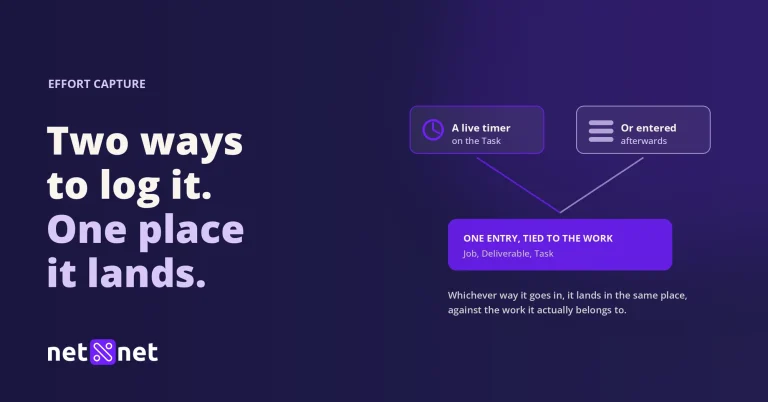
Net Net captures effort in the flow of work so the review is easier to do.
See your work before it drifts.
Net Net keeps plan and effort side by side, so you catch the slip while there is still time to act.
Start your free trial