
What the heck is Net Net anyhow?
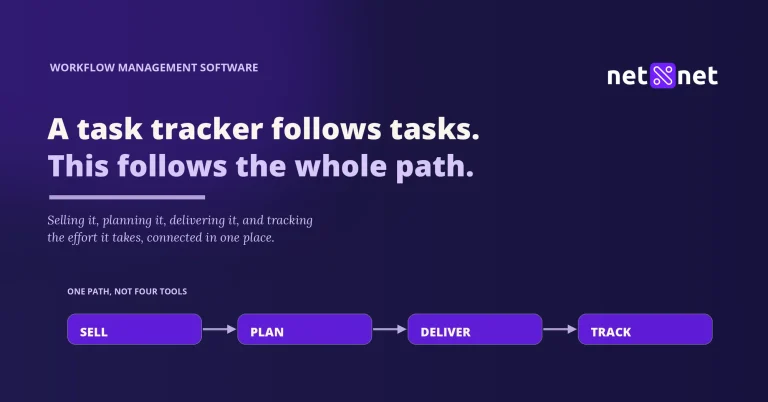
Net Net is workflow management software for creative and technical services firms. One place to sell, plan, deliver, and track every Job, so you can see how the work actually flows and catch drift before it turns into damage. The name comes from the question every owner keeps asking: what’s the net net on that Job?
No fishing boat required
Welcome, friend. We get the confusion.
Are we Alaskan fishermen hauling in crab and fish? Are we opening a sporting-goods warehouse full of basketball nets, hockey nets, and lacrosse goals? Did somebody like the word “net” so much that using it once felt insufficient?
All reasonable theories. None is correct.
We are after the intangible net. The answer that is left over once the noise, the activity, and the optimistic status updates have been stripped away. The question underneath the question.
Also, for the record, we have no useful advice about bait.
The question that became the name
The phrase came out of running a digital agency. When client work is moving in five directions at once, the owner keeps asking some version of the same thing.
What is the net net on that Job?
Not the polished meeting answer. Not the task count. Not the feeling that everyone looks busy. What is actually happening?
How is the Job flowing? Which Deliverable is drifting? What did the work take in effort? Who has capacity for what is coming next? Can the contractors doing the work participate without turning into another line of paid seats and logins?
Those answers do not calculate profit. They reveal the delivery truth your own business judgment needs. Profit is what follows when you can see those things clearly.
That distinction matters. The old version of this story promised money answers the product did not really own. The current product is more honest. It measures effort and timeline. Your accounting system owns dollars. You bring both truths together when you judge the result.
Related: What is workflow management software (and does your firm need one)?
What the system does today
The current version is built around Jobs, meaning projects and retainers. Each Job contains Deliverables, and the work inside those Deliverables becomes Tasks.
The plan gives each Deliverable pools of effort by Service Type: strategy, design, development, or whatever kinds of work your firm actually sells. That creates the baseline. As the team works, timers and manual entries capture actual effort against the Tasks where it happened.
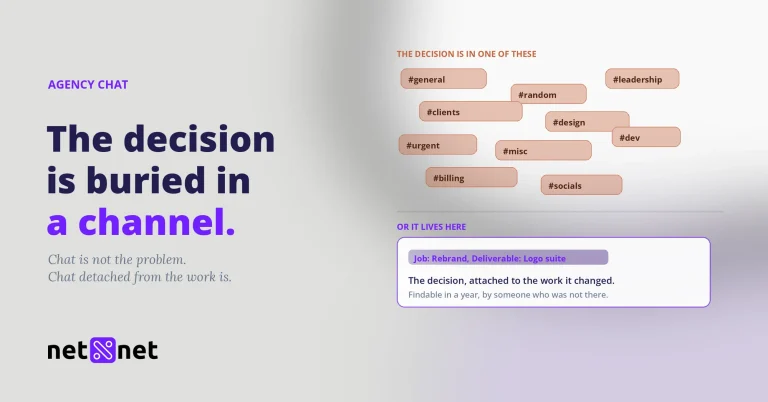
When scope changes, Change Orders preserve what was originally planned and record what got added. Chat stays attached to the Job, Deliverable, or Task it concerns, so a decision does not have to be reconstructed from a general channel three weeks later.
Performance dashboards show the effort and timeline picture while the Job is still alive. Reports let you review and export the underlying story. The purpose is not to grade people. It is to make drift visible early enough for an owner or lead to decide what happens next.
Quick Tasks handle the smaller requests that do not deserve a full Job but still need an owner, an effort expectation, and a due date. That keeps the tiny work from disappearing just because it arrived casually in a message.
Related: How do I compare estimated vs. actual effort on agency projects?
Who it is for
The system is for creative and technical services firms that sell client work and need to understand how that work moves from promise to delivery.
That covers agencies, design studios, web and dev shops, IT services firms, consultants, and similar teams where one owner tends to hold too much context in their head. It works for employees and contractors together, without charging for every person who needs access.
It is intentionally priced around active work: per active Job per month, with unlimited teammates and contractors. When a Job is no longer active, it stops counting toward that active-Job total.
Who it is not for
It is not accounting software. It does not calculate project profit, margins, invoices, or payments.
It is not an estimating or quoting engine. It preserves the delivery evidence that makes your next estimate smarter, but the sales price and the proposal still belong to your process.
It does not provide client logins. The product is for the people planning, delivering, and learning from the work.
It is also not built for a giant enterprise that wants to configure every department and approval chain inside one sprawling platform. The focus is smaller firms that want enough structure to see their work without hiring a systems administrator to keep the structure alive.
The name came out of the daily language of running a services firm. On any given job, someone would ask what the real result was once the effort, the revisions, and the overruns were accounted for. The net net. It stuck because it named the thing owners actually care about, and eventually it became the name of the product built to make that answer easy to see.
Why the name still fits
The software has changed. The owner’s question has not.
You can add one tool for tasks, another for time, another for chat, another for reporting. The answer may still depend on somebody pulling the pieces together by hand. Usually that somebody is the owner, sitting across from a peer at a coffee shop, trying to explain the state of a Job when the peer asks how the shop is really going.
The name is a reminder to keep asking for the real answer. What did we promise? What is the work taking? Where is it drifting? What deserves a decision now?
No grand mystery. No fishing fleet. Just a small firm trying to see its work clearly enough to run it well.
FAQ
Where does the name Net Net come from?
It comes from the question Marc kept asking while running his agency: “What’s the net net on that Job?” He wanted the answer underneath the task activity and the optimistic updates. How is the work flowing? Which Deliverable is drifting? What effort did it take? The phrase became shorthand for the delivery truth an owner needs before making the next decision.
Is Net Net a project management tool?
Task and project management are part of it, but the lead category is workflow management software. The product connects sales context, Jobs, Deliverables, Tasks, planned effort, actual effort, timeline, Change Orders, work-based chat, and Performance. A project management tool usually starts at the task list. This system follows the broader path from what was sold through what delivery actually took.
How much does Net Net cost?
Net Net is priced per active Job per month, not per user. A Job can be a project or a retainer. Teammates and contractors are unlimited, so the price does not climb every time another person needs access. The full trial runs for 60 days. The model is built for firms whose work and collaborator counts shift over time, without turning every collaborator into another paid seat.
See your work before it drifts.
Net Net keeps plan and effort side by side, so you catch the slip while there is still time to act.
Start your free trial