
How do I know it’s time to replace our task tracker?
It’s time when the tracker tells you what everyone already knows and misses what nobody does: tasks are done but the Job is late, effort is invisible, contractors live outside the system because seats cost money, and status takes a meeting to establish. A tracker lists work. You need to see how work flows.
When the question is not whether you need tracking, but whether your tracker still helps
Most small firms do not outgrow a task tracker all at once. The trouble usually shows up in small, familiar ways. A deadline slips even though the board looked fine. A contractor finishes the work, but the rest of the team never saw the handoff. A status meeting turns into detective work.
That is the moment to ask a harder question. Is your tracker helping the team deliver, or is it just recording activity after the fact?
The signs below are less about messy task lists and more about whether your system can still show the truth of a Job while there is still time to act.
1. Deadlines keep slipping, even when the tasks look done
This is usually the first sign. Cards move, checklists clear, and everyone has been busy all week. Then Friday arrives and the Deliverable is still not ready. The board was technically correct and operationally useless.
That gap matters. A task tracker can tell you whether a task was checked off. It often cannot tell you whether the deliverable tied to that task is still on track, whether upstream work drifted, or whether the overall Job is absorbing more effort than planned.
When deadlines pile up, the issue is not always that people are missing tasks. It is often that the system cannot connect tasks to the larger flow of delivery. If your team has to infer risk from scattered task updates, the tracker is already too shallow for the work.
2. Nobody is fully sure who owns the next move
You can hear this problem in meetings: “I thought Sam had it.” “Was that for design or dev?” “Did the contractor finish their part?” Ambiguity about ownership creates duplicate work, missed handoffs, and that constant low-grade feeling that someone is about to be surprised.
Most trackers let you assign a task. That is not the same as making ownership clear inside the real delivery structure. Teams need to see who owns the deliverable, who is executing which task, and what happens next if the work changes.
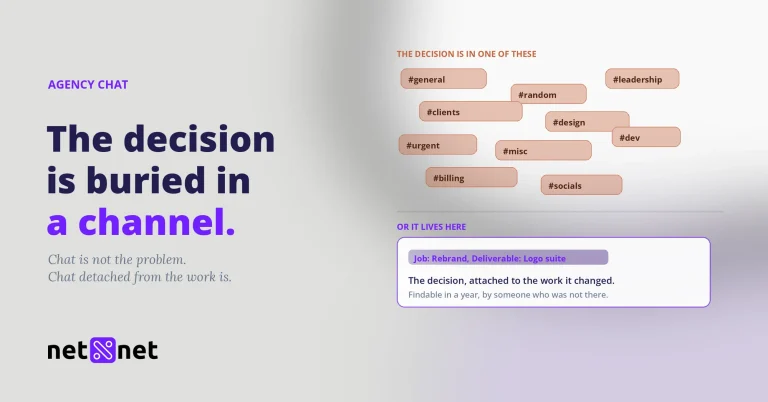
If your people still have to hunt through chat, spreadsheets, or side notes to establish responsibility, the tracker is not giving you clarity. It is giving you one more place to look.
3. The team spends more energy firefighting than flowing
When a system is too thin, it pushes the team into reactive work. Deadlines appear suddenly. Scope changes land informally. Priorities shift in chat. Everyone is trying to keep the Job moving, but nobody can see the full shape of the work clearly enough to intervene early.
After a few rounds, firefighting starts to feel normal. The tracker records every frantic update but gives the team no early warning that the Job is sliding. It becomes a tidy history of the scramble.
A useful system gives the lead a chance to act before the emergency meeting appears on the calendar. If the tracker only tells a coherent story after something goes wrong, it is too late for the Job you are trying to run.
4. You can see completed tasks, but not meaningful progress
Completed tasks can create false confidence. A board with a lot of green may still hide a Job that is burning more effort than expected, stalling on one major deliverable, or leaning too hard on a few people to keep things moving.
That is the core limitation of task-only visibility. It tells you activity happened. It does not reliably tell you whether the plan still holds.
Small firms need more than counts of completed work. They need to see progress in context: deliverables moving forward, effort against plan, and whether the Job is staying inside the shape it was supposed to follow. If the only way to know that is to ask around, the tracker is no longer enough.
5. Your stack has turned task tracking into translation work
This is the most obvious sign, and often the most expensive. Sales lives in one tool, tasks in another, effort somewhere else, and chat wherever somebody could get a quick answer. Each system owns one slice of the story, so your team spends the week stitching it back together.
That slows everything down. People re-enter details, repeat status updates, and carry context in their heads. Contractors get left out because bringing them into every tool costs too much or creates too much friction. Status gets reconstructed in meetings because no single place shows the whole Job clearly.
When the stack forces people to translate the work from tool to tool, the problem is no longer task tracking. It is that your system cannot show how the work flows. That is the point where workflow management software becomes the better fit. What is workflow management software (and does your firm need one)?
How replacing the tracker changes agency performance
Replacing a tracker is not about getting prettier boards or more notifications. It is about moving from a list of tasks to a connected view of delivery.
Once work is structured around Jobs, Deliverables, Tasks, and visible effort, a few things change fast:
- Deadlines stop being isolated promises and become part of a visible delivery path.
- Ownership becomes clearer because tasks sit inside real deliverables, not loose lists.
- Drift shows up sooner because effort and status live with the work.
- Contractors can work in the same flow as the rest of the team.
- Status meetings get shorter because the system answers more of the questions up front.
That shift matters most for small firms because every Job counts. You do not need a bigger pile of features. You need a clearer view of what the work is doing while you still have room to steer it.
What to look for in the system that replaces it
If you are evaluating what comes next, start with the gaps your tracker cannot cover.
The replacement should connect Jobs, Deliverables, and Tasks in one structure. Your team should be able to record effort with the work and spot drift before the client hears about it first. Contractors should be able to participate without starting a debate over seats. Owners and leads need a useful daily view, plus reports they can export when the information needs to leave the system.
Most of all, it should help you understand the flow of work, not just document activity. That is the difference between a tracker you tolerate and a system that actually helps you run the firm.
Where to begin without disrupting delivery
You do not need a heroic migration plan to know whether a change is warranted. Start by auditing one recent Job:
- Where did the team go to check status?
- Where did ownership get fuzzy?
- Where did effort become hard to see?
- Where did contractors or partners fall outside the system?
- Where did the real story of the Job live, in the tracker or in people’s heads?
If those answers keep pointing outside the tracker, you have your answer.
From there, define the few capabilities the new system must handle cleanly, run one contained Job through it, and judge it on whether status becomes easier to establish and drift becomes easier to catch. That is a more useful test than asking whether the interface looks familiar.
The Bottom Line (Your Net Net)
Replace the tracker when it can no longer show what is happening while there is still time to do something about it. If the team is busy but the Job is late, status still requires a meeting, and the useful context lives everywhere except the tracker, task management is not the real problem anymore. You need workflow visibility.
FAQ
Can’t we just clean up the tracker we already have?
Sometimes, yes. If the main problem is inconsistent use, better habits may help. But if the underlying issue is structural, meaning the tracker cannot connect tasks to deliverables, effort, and overall Job status, cleanup will only make the same limitation look neater. That is when replacement becomes the more honest fix.
What should replace a task tracker for a small firm?
Look for workflow management software, not just a more polished board. Small firms need one place to see Jobs, Deliverables, Tasks, effort, and status together. The point is not to watch people more closely. The point is to make the truth of delivery easier to see before drift becomes damage.
How do we switch systems without slowing active Jobs?
Do it in a controlled slice. Pick one contained Job or one repeatable work type, define the structure up front, and let the team use the new system without forcing a full-company reset on day one. You are testing whether visibility improves, not proving your appetite for disruption.
See your work before it drifts.
Net Net keeps plan and effort side by side, so you catch the slip while there is still time to act.
Start your free trial