
What is drift? The name for what’s quietly happening to your projects.
You’ve said it. Maybe this week. “Something’s off with the Henderson Job.” You can’t point at what. Nothing’s late yet, nobody’s upset, the work is good. And still.
That feeling has a name, and most small creative and technical firms don’t have it in their vocabulary, which is a problem, because you can’t catch something you can’t name. We call it drift. Here’s what it is, what it isn’t, the three forms it takes, and how to see it while it’s still a Tuesday conversation instead of a Friday apology.
Drift is the gap between the Job you planned and the Job you’re delivering, and it’s dangerous because it opens slowly. No single moment feels like a problem. The client asks for one more option and it’s a fair ask. The developer spends an extra afternoon on a stubborn integration and it’s the responsible thing to do. The revision round runs to four because the third one was close. Every step is reasonable. Add them up over six weeks and the Job is nowhere near the plan you sold, the effort is well past the estimate, and the date has become a conversation. Nobody did anything wrong. The work just went off course while everyone was busy doing it well.
Where the word comes from
Think of a boat with the engine off. It isn’t going anywhere on purpose. The current moves it, a little at a time, and if nobody looks up from the deck it ends up a long way from where it was pointed. Nobody steered wrong. Nobody steered at all.
That’s how Jobs go sideways in small firms. Rarely through one big decision. Usually through dozens of small, sensible ones made by people trying to do good work, with no single place where the sum of those decisions is visible. The owner feels it before anyone can prove it, which is why “something’s off” comes out of every agency owner’s mouth well before they can say what.
Drift is the name for the what.
What drift is not
It’s not scope creep, though scope creep causes it. Scope creep is the requests. Drift is what those requests do to the plan when nobody re-plans. You can have drift with zero scope creep: the scope stays exactly the same and the work takes longer than anyone estimated.
It’s not a missed deadline. A missed deadline is the end of the story. Drift is the middle, the weeks where the date was still technically fine and the effort was trying to tell you otherwise.
It’s not a budget overrun either, though it usually turns into one. Drift lives in effort and timeline, the two things you can see while the Job is still moving. What that means for the money is a separate conversation, and always a downstream one.
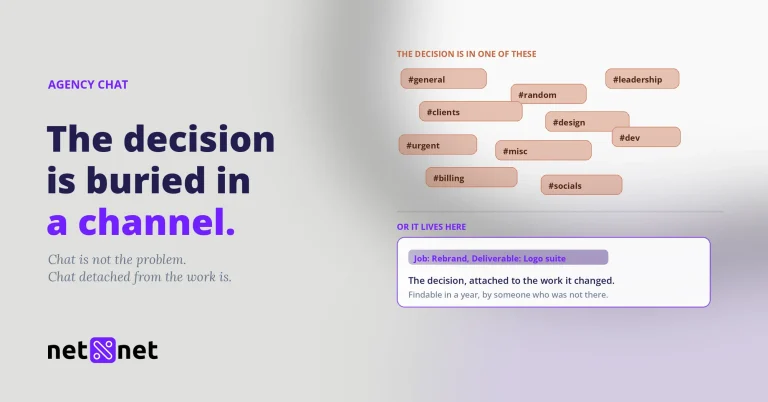
And it isn’t anyone’s fault. This part matters. Drift isn’t the account lead being soft or the developer being slow or the client being difficult. It’s what happens when the plan lives in a proposal, the effort lives in a timesheet, the schedule lives in someone’s head, and nothing connects them. Disconnected tools make drift invisible, and invisible drift grows.

The three ways a Job drifts
Effort drift. The Deliverable is exactly what you promised, and it’s taking half again as much effort as you planned. The design needed more rounds. The content took longer to gather. Nobody added anything; it was just heavier than it looked, like a suitcase after a trip. We wrote about reading this in How do I compare estimated vs. actual effort on agency projects?, because plan versus actual is the first place effort drift shows.
Timeline drift. The effort is on plan but the calendar isn’t. The client took eleven days to approve a comp that was planned for three. A contractor was double-booked. Now the Job is on plan in effort and three weeks late in life. The difference between these two kinds is the whole subject of cost variance versus schedule variance, and small shops mix them up constantly.
Scope drift. The Deliverable has become a different Deliverable. “The landing page” now has a quiz on it. “The monthly report” now has a video summary. Nobody wrote a change order because each addition was small and the client was nice about it, and the plan still describes the old thing.
Most Jobs have all three going at once, in different amounts. That’s why gut feel isn’t enough. You can sense something’s off. You can’t sense which kind, or how much, or whether it’s the kind that fixes itself by Thursday.
How to see it early
Drift is only invisible when the plan and the actual live in different places. Put them side by side and it announces itself.
Plan the Job as Deliverables, each with an effort estimate and a timeline. Not “website, 80 hours.” Discovery, design, build, content, launch, each with its own number and its own window.
Log effort against the Deliverable, by whoever did it, the day it happened. Contractor, employee, or the time your senior spent fixing an AI draft, it all lands on the Deliverable.
Look at plan versus actual while the Job is live. Weekly is fine. For each Deliverable: is the actual pulling away from the plan, and is the calendar pulling away from the window? When it is, that’s the moment. That week, not the end of the Job.
Name it out loud. “Design is at fourteen against a plan of ten, and we’ve got two rounds left.” Once it has a name and a number, it’s a decision. Re-plan the Deliverable, write the change order, move the date, or accept it and know you accepted it. Any of those is fine. Not knowing is the only bad option, and it’s the default.

What drift costs you when you can’t see it
The obvious cost is the Job itself: the effort you didn’t plan for, the date you had to move, the awkward call.
The quieter cost is the next Job. If the last three website builds drifted and nobody measured it, your record says they took what you estimated. So you estimate the fourth the same way, and it drifts the same way. Drift you can’t see doesn’t just hurt this Job. It corrupts every estimate after it, politely, forever.
The cost nobody puts on a spreadsheet is the owner. Drift you can feel but can’t prove is exhausting. You know something’s wrong, you can’t point at it, so you carry it around. Seeing it doesn’t make the Job easier. It makes the weight something you can set down.
The Bottom Line
Drift is work going off course, slowly, for reasonable reasons, while everyone’s busy doing it well. Flow is the other half: effort landing where you expected, the calendar holding, handoffs happening without a chase. Flow doesn’t mean nothing changes. It means when something changes, you see it, you re-plan, and the Job keeps moving on purpose.
You won’t prevent every surprise; nobody does. Plan by Deliverable, log effort where it happens, and look at plan versus actual weekly. Once you can name drift, you can catch it. Once you can catch it, it stops running your weeks.
FAQ
Is drift the same as scope creep?
No. Scope creep is one cause of drift, the one where the Deliverable grows. Drift also happens with no scope change at all, when work takes more effort or more calendar than planned. Scope creep is a request. Drift is the gap.
How much drift is normal?
Some, always. Estimates are forecasts, not contracts with reality. The question isn’t whether a Job drifts but whether you see it early enough to decide what to do about it. A Job that drifts and gets re-planned in week two is healthy. One that drifts silently to week eight is a story you’ll tell at a conference someday.
Can a retainer drift?
Retainers drift more than anything, because there’s no end date to force the conversation. The monthly effort grows past what the retainer covers, and it’s still “the same retainer.” Plan the month as Deliverables and compare, the same as a project.
See your work before it drifts.
Net Net keeps plan and effort side by side, so you catch the slip while there is still time to act.
Start your free trial